

Webinar Recording: Genetic Biocontrol of New World Screwworm and Spotted Wing Drosophila

The New World screwworm is a serious livestock pest because it lays eggs in wounds or natural openings like ears, and the larvae feed on living tissue. Recently, the New World screwworm has been making a return, spreading north through Central America and into Mexico.

In this webinar, Dr. Maxwell Scott, a professor in the Department of Entomology and Plant Pathology at North Carolina State University, shares how his research has the potential to reduce, or even eliminate, New World screwworm populations.

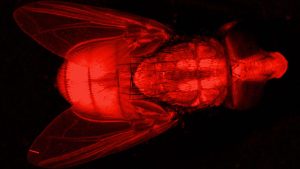
Fluorescent imaging of a New World screwworm fly. Photo courtesy of NC State.
Female New World screwworm blowfly showing red inflorescence. Photo by Carolina Concha.

The current sterile insect technique (SIT) requires many New World screwworm male flies to be reared and released because it takes 10 times more sterile males than female flies for the population to decline. Typically, both male and female flies have been reared, sterilized and released. However, Dr. Scott’s team is working to develop genetics that will allow only male flies to grow into adulthood.

Rearing only males saves resources by not having to feed females, which do not contribute to lowering wild populations. Second, the female New World screwworm flies require more radiation to make them sterile so producing male-only flies saves costs on electricity and helps the radiation equipment last longer.  

Genetic breeding efforts are being explored on spotted wing Drosophila as well. Flies are raised in the lab on a diet that includes tetracycline, and the females must have tetracycline in their diet to survive. The males are modified to carry a gene called a “female killing gene.” When the males are released into the wild, they mate with wild females, producing offspring.

All female offspring of these modified males will die because tetracycline is not available in the wild. The male offspring survive but still carry one copy of the female killing gene. So these males may even pass the gene to their female offspring, reducing the number of females in an additional generation. 

While more work is needed before these techniques are widely used, they have excellent potential to make it easier to control these pest flies. Ideally, the female killing gene will be explored as a genetic biocontrol option for New World screwworm as well. Preliminary results seem promising, but more research is needed.  

Learn more about this research progress by watching the full webinar.

PresenterProfile picture of Dr. Max Scott, a professor at North Carolina State University.

Max Scott

Professor, North Carolina State University

Dr. Max Scott works on developing genetic systems for controlling insect pests. His team has developed technologies for genetic manipulation and gene editing for several insect species to facilitate this work.