
Webinar Recording: Are You Smarter Than a Lone Star Tick?
If you’re interested in staying informed about ticks and tick research, Dr. Holly Gaff from Old Dominion University is someone to follow. She’s been researching ticks since the 90s, and has been consistently collecting tick data every month at more than 15 sites in Virginia since 2009.
Prepare to be fascinated (and a little unsettled) as Dr. Gaff shares her expertise in “Are You Smarter than a Lone Star Tick?”
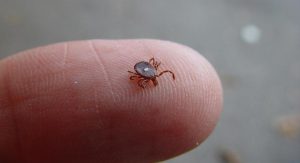
Dr. Gaff begins with some trivia-worthy tick information: there are about 875 tick species worldwide, and they’ve managed to colonize every continent—even Antarctica. These tiny acarids feed on nearly every vertebrate animal in the world.
Most tick species have multi-stage life cycles that require three separate blood meals. In between feedings, they hide in leaf litter or brush, waiting months or years for their next host.
While collecting tick data, Gaff has had the opportunity to learn a great deal about the lone star tick (Amblyomma americanum). In Virginia, it dominates the landscape, making up as much as 90–95% of ticks collected.
Lone star ticks prefer large mammals, and white-tailed deer are their favorite host. However, these ticks, including lone star larvae, will happily feed on humans.
Lone star ticks thrive in wooded areas and forest edges, but this species actively quests for its hosts so you can also find them in tall grass, suburban spaces, and even parking lots. Over the past 20 years, their range has expanded to include the states of Indiana, Ohio, Illinois, with confirmed sightings in South Dakota, halfway through Michigan and even in Maine.
Fortunately, lone star ticks do not transmit Lyme disease; unfortunately, they can spread other tick diseases with similar symptoms. These diseases include Ehrlichiosis and southern tick associated rash illness (STARI). Lone star ticks are also associated with alpha-gal syndrome, a condition that includes allergic reactions to red meat after a lone star tick bite.
Dr. Gaff’s lab has been exploring methods to manage lone star tick populations. So far, the researchers have determined that lone star ticks are remarkably tough.
Adults can survive drowning (for over a month!) whether in fresh, salt, or brackish water. Ground temperatures where ticks hide, not just air temperatures, must fall below freezing in order to kill them.
These ticks can even survive high temperatures. In a dryer set on “high” heat, 10 minutes may be enough to kill them. However, if you wash clothing before drying, it takes much, much longer for this tick species to dry out and die. The dryer needs to run at least an hour on high. Research on ideal dryer timing is in progress.
While acaricides are effective against lone star ticks, it’s important to consider environmental impacts of spraying them widely for tick control. Dr. Gaff’s team is experimenting with a tick bot that can treat a targeted area with acaricide.
The acaricide is applied to a cloth, which drags behind the tick bot and spreads the pesticide directly on the leaves and grass. This strategy is effective at killing ticks where the tick bot is used and shows promise as an effective management strategy.
Learn more about this research progress by watching the full webinar.
Presenter

Holly Gaff
Professor and Chair of Biological Sciences at Old Dominion University
Dr. Holly Gaff is a professor at Old Dominion University, and she leads the ODU Tick Research Team. Her background is in mathematics, but her interests are more broadly focused on the ecology and epidemiology of ticks and tick-borne illnesses.
The Tick Team has been conducting active surveillance in the Hampton Roads area of Virginia since 2009, and numerous projects have grown out of the findings from this work.