North Central IPM Center Updates
2025 Funds Available
The North Central Integrated Pest Management (IPM) Center has approximately $360,000 of funding available for 2025 projects related to integrated pest management. Applicants may request a maximum of $30,000 per project. Projects may increase collaboration, fund research or promote pest management in communities. More details are available on the North Central IPM Center website. Applications are due on Friday, November 22. Other regional IPM centers also have grant opportunities available. Northeastern IPM Center: RFA is available now; applications are due Thursday, November 7. Southern IPM Center: RFA is available now; applications are due Friday, Nov 22. Western IPM Center: RFA will be posted Wednesday, Oct. 2; applications are due Friday, Dec. 6.Reframing Farming: A Workshop for Midwest Farm and Food Communicators
Hey Midwest farm and food communicators!- Are you hungry for effective ways to convey the complexities of farming with the public or people who have little experience with agriculture?
- Do you want to have more productive conversations about farming practices that are sustainable, organic, conventional, or regenerative?
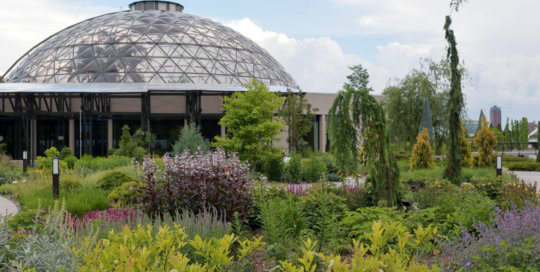 Des Moines Botanical Center conservatory and garden. Photo by Kelly Norris.
October Webinar: Asiatic Garden Beetle as an Emerging Pest of Corn
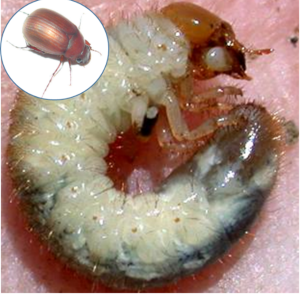 Asiatic garden beetle adult (top left) and larvae.
Asiatic garden beetles have been in the United States for 100 years, but the beetles are now emerging as a field crop pest in the Midwest. During the next “Pests and Progress” webinar, Dr. Kelley Tilmon, Ohio State extension specialist for field crop entomology will share recent research on Asiatic garden beetles, an emerging pest of corn and other crops.
This webinar will be held on Wednesday, October 16 at 1:30 pm ET (12:30 pm CT). “Pests and Progress” webinars are free, and more details are on the North Central IPM Center website.
Asiatic garden beetle adult (top left) and larvae.
Asiatic garden beetles have been in the United States for 100 years, but the beetles are now emerging as a field crop pest in the Midwest. During the next “Pests and Progress” webinar, Dr. Kelley Tilmon, Ohio State extension specialist for field crop entomology will share recent research on Asiatic garden beetles, an emerging pest of corn and other crops.
This webinar will be held on Wednesday, October 16 at 1:30 pm ET (12:30 pm CT). “Pests and Progress” webinars are free, and more details are on the North Central IPM Center website.
Webinar Recording: Phomopsis Stem Canker of Sunflower – Is Fungicide Resistance Becoming an Emerging Problem?
Dr. Febina Mathew, associate professor of plant pathology at North Dakota State University and John Swanson, president of the Minnesota Sunflower Grower’s Association, shared recent research regarding control of Phomopsis stem canker. Their webinar called, “Phomopsis Stem Canker of Sunflower – Is Fungicide Resistance Becoming an Emerging Problem?” explained that Phomopsis stem canker can reduce sunflower seed production by 40% and sunflower seed oil content by 10%. Phomopsis stem canker is often mistaken for Sclerotinia, another disease that inffects sunflowers, but Phomopsis continues to spread and is thought to be the most limiting factor for successful sunflower production in Minnesota. Once established, Phomopsis stem canker is difficult to defeat. It can infect a number of crops and even weeds, and it can overwinter in crop residues. Effective management options are needed. Efforts to breed or discover a resistant sunflower variety are in progress but have been unsuccessful so far. Currently, farmers are advised to manage Phomopsis stem canker by using Quinone outside Inhibitor (QoI) fungicides. However, resistance to QoI has been confirmed in one strain of the Phomopsis pathogen: Diaporthe helianthi. In order to effectively address fungicide resistance, it is recommended to employ a combination of chemicals with different modes of action. Learn about recent field trials conducted in Minnesota, North Dakota, Nebraska and South Dakota to assess new fungicide chemistries and application timings.Sustainable Landscaping Initiative
You are invited to attend the free Schoolyard Maintenance Virtual Workshop on Thursday, September 26 at 5 pm ET (4 pm CT). During this webinar, schoolyard maintenance expert Ryan Anderson will review the schoolyard maintenance calendar, share case studies of well-maintained schoolyards and answer questions from webinar attendees. This webinar is sponsored by Midwest Grows Green (MGG) sustainable landscaping initiative and Reflow.Webinar: School Nurses: Crucial to School IPM Program Success
School nurses have the opportunity to act as a communication hub for both students and staff regarding health concerns. School nurses can serve several important roles to aid schools in being healthier environments for students. In this webinar, Hillary Peterson, IPM specialist in the Maine Department of Agriculture, Conservation and Forestry will cover how school nurses can play a crucial role in coordinating efforts and notifying staff and administration about ticks, indoor air quality issues, pesticide exposure, and rash prevention. This webinar will be held on Friday, October 4 at 1:00 pm ET (12:00 pm CT).Pests and Progress Speaker Signup
- Have you been working to understand a new pest issue?
- Have you found a solution worth sharing with others?
- Do you have recently published research to share?
War Against Weeds Podcasts
- 2024 Summer Recap Interviewees: Kody Came (farmer from Kansas), Austin Sundeen (farmer from North Dakota), and Greg McGlinch (farmer from Ohio)
- Cover Crop Trade-Offs Interviewees: Dr. Logan Simon, southwest area agronomist, Kansas State University; Dr. Travis Legleiter, assistant professor, University of Kentucky
- EPA ESA Update Interviewees: Dr. Bill Chism, retired from US Environmental Protection Agency, Chair of the Weed Science Society of America’s Endangered Species Act Committee; Ashlea Frank, consultant with Compliance Services International
New Episodes—I See Dead Plants Podcasts
- Kidney Shaped Creatures- Reniform Nematode on Cotton Interviewee: Dr. Kathy Lawrence, professor, Auburn University, Alabama
- Sweet Potato Stranglers: An Overview of Root Knot Nematode Part 1 Interviewee: Dr. Will Rutter, research plant pathologist, USDA Vegetable Laboratory in Charleston South Carolina
- Sweet Potato Stranglers: An Overview of Root Knot Nematode Part 2 Interviewee: Dr. Will Rutter, research plant pathologist, USDA Vegetable Laboratory in Charleston South Carolina
IPM Highlights
Fooling Fruit Flies
Spotted wing drosophila (SWD) is a troublesome insect that infests healthy, ripe fruits such as raspberries and blueberries. This insect is difficult to control with pesticides since larvae feed inside the fruits. This new technique uses unappealing odors to trick SWD into avoiding healthy fruits.
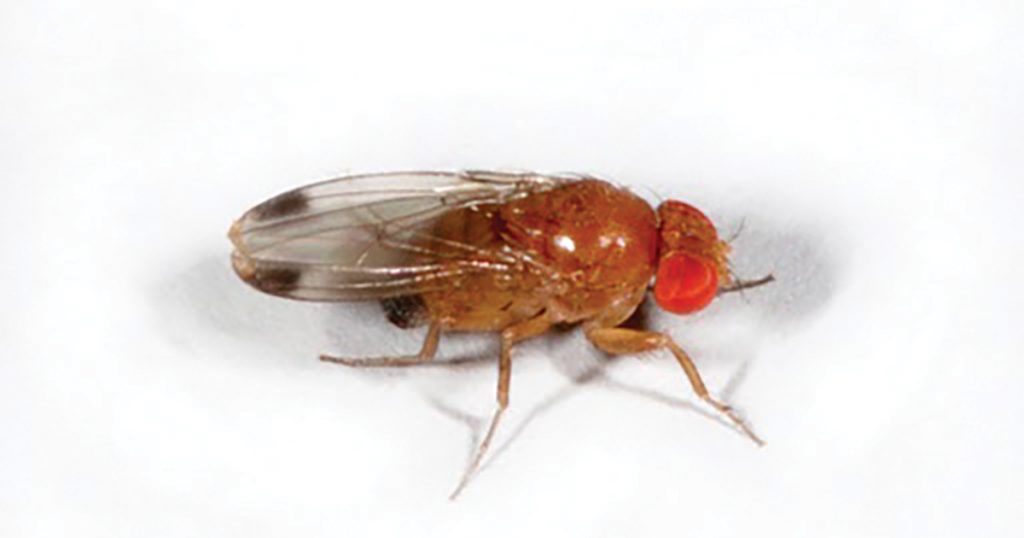
Male adult spotted wing drosophila.
Photo by Martin Hauser.
Soybean Invertebrate Loss Estimates from the United States: 2023
Pests such as insects, mites, and mollusks reduce soybean yield every year. Check out this new publication to see how 2023 invertebrate pest pressure affected soybean yields. See which invertebrates cause the most yield loss, and review the costs spent on insecticides in soybean-producing states.
Increasing Access to Practical Biocontrol Information through Digital Resources
In the past year, the New York State Integrated Pest Management Program has added profiles of individual biocontrol agents to its website. Additional resources developed through the Augmentative Biocontrol (ABC) Working Group will soon be added as well.
The goal of this effort is to provide practical information that addresses barriers to biocontrol adoption and helps growers and gardeners successfully implement biocontrol. During this webinar, speakers will provide a tour of biocontrol agent profiles and describe the ongoing process and progress to create resources on augmentative biocontrol.
Speakers will include Dr. Amara Dunn-Silver, biocontrol specialist Cornell University and Dr. Hillary Peterson, integrated pest management specialist at the Maine Department of Agriculture, Conservation and Forestry.
The webinar will be held on Wednesday, October 2, 2024 at 11:00 am ET (10 am CT).