
Yellow-Legged Hornet
Free printed copies of pest alerts are available.
Adult yellow-legged hornets (Vespa velutina) were confirmed in Georgia and South Carolina for the first time in 2023. While this hornet is native to tropical and subtropical areas of Southeast Asia, it has also spread to much of Europe and parts of the Middle East and Asia.
Yellow-legged hornet adults consume carbohydrates such as flower nectar, ripening fruit, or tree sap, but the hornet’s larvae require a diet of animal protein.
Yellow-legged hornets are known to target Apidae (the insect family including honey bees) to feed their young (Turchi and Derijard, 2018). Hornets often wait outside beehive entrances and pick off honey bees as they come and go from the hive. As the hornet colony grows, the demand for food increases, and aerial assaults can devastate hives.
Even when these hornets do not directly kill a significant number of bees, the hornet’s presence can make bees avoid leaving the hive and cause colonies to decline. The yellow-legged hornet is an important pest because it has the potential to reduce honey production and production of package bees and queens.
These hornets could affect pollinator populations, which may also affect production of crops that depend on pollinators. The Georgia Department of Agriculture, in cooperation with USDA Animal and Plant Health Inspection Service Plant Protection and Quarantine, Clemson University and the University of Georgia, is working to eradicate yellow-legged hornets from the area.
Identification
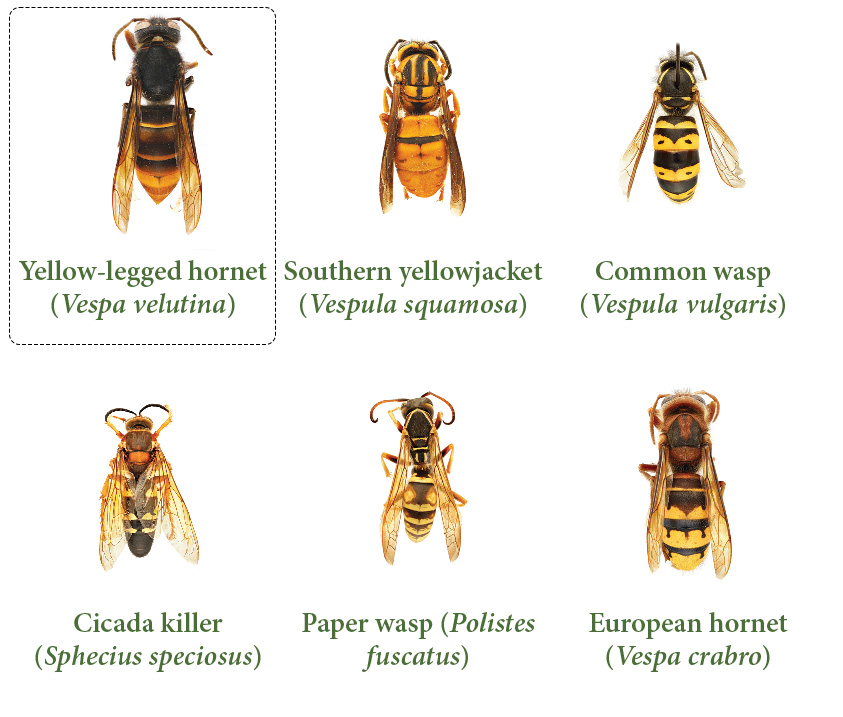
Yellow-legged hornets are relatively large from 0.7 to 1 inch long but can be challenging to identify because other species look similar. Use the following characteristics to identify yellow-legged hornets.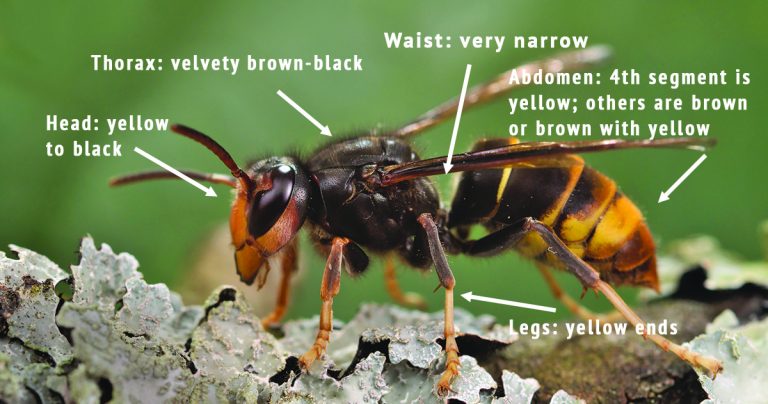
Look-Alike Species
Life Cycle
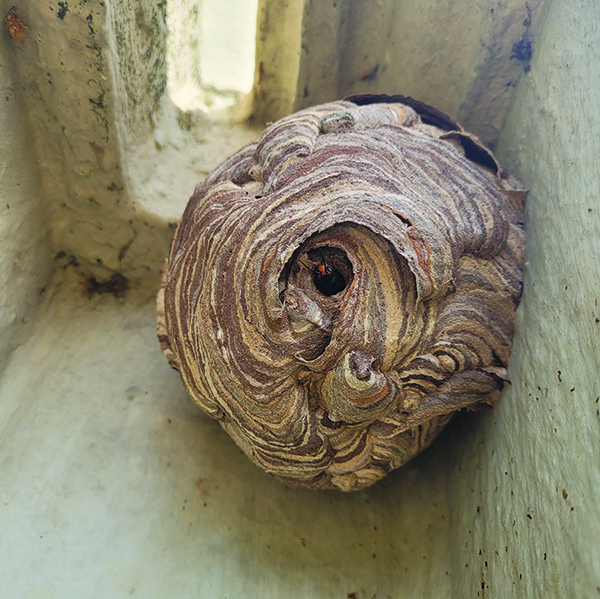
The life cycle of yellow-legged hornet is similar to other hornet species. Mating occurs in the fall. Young, mated females hide in secluded spaces in trees or in leaf litter for the winter and emerge in spring to build a round to oval paper nest from macerated wood pulp.
These primary nests may be located in cavities in the ground, in a rock, or aboveground in low bushes or man-made structures (Archer, 2008). The female lays eggs in the cells of the nest, cares for the larvae, and defends the nest until the young hornets take over so the mother can focus on egg laying.
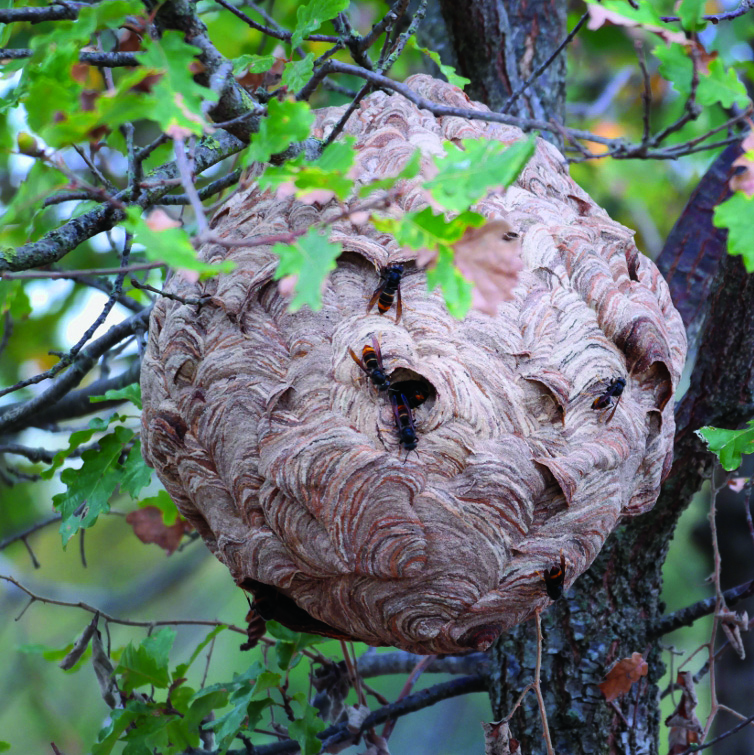
While the first early-season nest may be near the ground, a growing colony usually relocates to higher locations in tree branches or on rock walls higher than 32 feet (Archer, 2008). These secondary nests are egg-shaped like many hornet nests and may hold 6,000 worker hornets on average (Sullivan, 2023).
As fall approaches, the colony rears females and males, which will leave and find mates. Only mated females survive the winter to begin new colonies in the spring.
Management
The best way to control yellow-legged hornets is to destroy their nests, which should only be attempted by professionals. Ideally, traps will be set early in the season to capture queens as they emerge and begin new nests. Even catching worker hornets is useful because they can be tracked to help locate a nest.Elimination of Hornet Nests
If a yellow-legged hornet sighting is confirmed, local authorities may launch an effort to find and eliminate the nest. Yellow-legged hornets forage up to 1,000 m from their nest, which can be used to determine a search radius (Poidatz et al., 2018). Traps are set near an apiary, and hornets are spotted and followed to find additional locations to place traps until the nest is located. Researchers in Europe have developed radio-tracking methods to improve the speed and efficiency of finding nests which can be hidden and hard to reach (Kennedy et al., 2018).Protecting Hives
Beekeepers can try several options to protect hives from yellow-legged hornets. If the hornet numbers are still low, it is possible to kill hornets with a badminton racket. Their habit of guarding hive entrances makes them relatively easy to find. Be sure to wear protective clothing when using this method.Modified Hive Entrances
Modified hive entrances can be purchased to exclude hornets from hive entrances. While they do keep hornets out of the hive, bees are still vulnerable as they enter and exit the alternate entrance.Traps
An inexpensive homemade trap can be made with a one-liter soda bottle. The top third of the bottle is removed, flipped, and placed back inside the remaining bottle. Bait solution is added to fill half the bottle, and the traps should be placed near hives. This trap is likely to catch a variety of wasp species so it will be important to check the trap and determine if yellow-legged hornet is present. Bait for traps can be made at home or purchased. Sweet baits should be used until early summer. You can create your own bait by mixing two parts grape juice with one part brown sugar (e.g., 2 cups juice and 1 cup brown sugar). Once the colony is rearing young, protein-based lures may be more effective. Yellow-legged hornet traps have been commercialized by a few European companies and include electric traps and one-way tunnel traps. These traps have not performed well in research trials (Lioy et al., 2020).Report Sightings
The public’s help is needed! Trap suspected hornets and photograph them with care. If they have characteristics of the yellow-legged hornet, submit the photo to the Georgia Department of Agriculture. If the sighting is confirmed, be sure the sighting is also reported on EDDMaps. In 2023, five yellow-legged hornet nests were found and destroyed in Georgia.Resources for More Information:
For beekeepers (scroll down to Beekeeper Resources)
Video showing how to build a trap
Georgia Infestation and Eradication Progress Updates.
The Regional IPM Centers Database has more resources
References
Alabama A&M & Auburn Universities Extension. 2024. Yellow-legged hornets in the southeast. Alabama Extension. https://www.aces.edu/blog/topics/bees-pollinators/yellow-legged-hornets-in-the-southeast/
Archer, M.E. (2008). Taxonomy, distribution and nesting biology of species of the genera ProvespaAshmead and Vespa Linnaeus (Hymenoptera, Vespidae). Entomologist’s Monthly Magazine, 144:69–101.
Georgia Department of Agriculture. (2023a). Discovery of Yellow-Legged Hornet Confirmed in Georgia for the First Time. https://agr.georgia.gov/pr/discovery-yellow-legged-hornet-confirmed-georgia-first-time.
Georgia Department of Agriculture. (2023b). Yellow-Legged Hornet Watch Report Form. https://survey123.arcgis.com/share/7b8255c0dbbd41daadd269d0ae2eb36a.
Kennedy, P., J. Ford, S. M. Poidatz, J. Thiry & L. Osborne. (2018). Searching for nests of the invasive Asian hornet (Vespa velutina) using radio-telemetry. Communications Biology, 1:88. https://doi.org/10.1038/s42003-018-0092-9.
Lioy, S., D. Laurino, M. Capello, A. Romano, A. Manino, & Porporato. (2020). Effectiveness and selectiveness of traps and baits for catching the invasive hornet Vespa velutina. Insects, 11:706. https://doi.org/10.3390/insects11100706.
Poidatz, J., K. Monceau, O. Bonnard, & Thiry. (2018). Activity rhythm and action range of workers of the invasive hornet predator of honeybees Vespa velutina, measured by radio frequency identification tags. Ecology and Evolution, 8:7588-7598.
Sullivan, W. (2023, August 18). Invasive Yellow-Legged Hornet Spotted in the U.S. for the First Time. Smithsonian Magazine.
Turchi, L., & Derijard. (2018). Options for the biological and physical control of Vespa velutina nigrithorax(Hym.: Vespidae) in Europe: A Review. Journal of Applied Entomology, 142:553-562.
University of Georgia Bee Program. (2023). Yellow-Legged Hornet. https://bees.caes.uga.edu/bees-beekeeping-pollination/yellow-legged-hornet.html.html
Washington State Department of Agriculture. (2024). Invasive hornets. Washington State Department of Agriculture. https://agr.wa.gov/hornets
Acknowledgments
Author: Jacqueline Pohl (North Central IPM Center)
This work is supported by the Crop Protection and Pest Management Program (2022-70006-38001) from the USDA National Institute of Food and Agriculture.
For information about the Pest Alert program, please contact the North Central IPM Center at northcentral@ncipmc.org.
May 2024