Spotted Lanternfly

Free printed copies of pest alerts are available. 

The spotted lanternfly (SLF) (Lycorma delicatula) is an invasive sap-feeding planthopper first discovered in the United States in Pennsylvania in 2014. Field observations indicate that the tree of heaven, Ailanthus altissima, is an important host plant; however SLF is known to feed on a wide range of hosts, including wild and cultivated grapes, stone fruits, willow, and various hardwoods. This species is thought to be native to China, Vietnam, and Japan.

To date in the United States, serious damage and plant death from SLF feeding has been observed in three of the insect’s preferred hosts: tree of heaven, black walnut saplings, and grapevines. As such, SLF is a serious economic threat to viticulture. Although SLF has less severe economic impacts on other plant hosts, such as fruit trees, ornamental plants and timber, it does pose an economic threat to related industries. Heavy feeding by SLF on these hosts, particularly over multiple years, can weaken plants, making them more susceptible to other stressors.

The mere presence of SLF can have economic impact, in terms of keeping shipments and conveyances free of SLF to meet quarantine regulations (e.g., for nurseries), or to reduce the unsightly appearance of high infestations (e.g., at commercial or agritourism sites). Given the wide range of hosts it feeds upon, and the wide number of habitats in which it is found, SLF poses a significant threat to a wide range of industries.

Identification

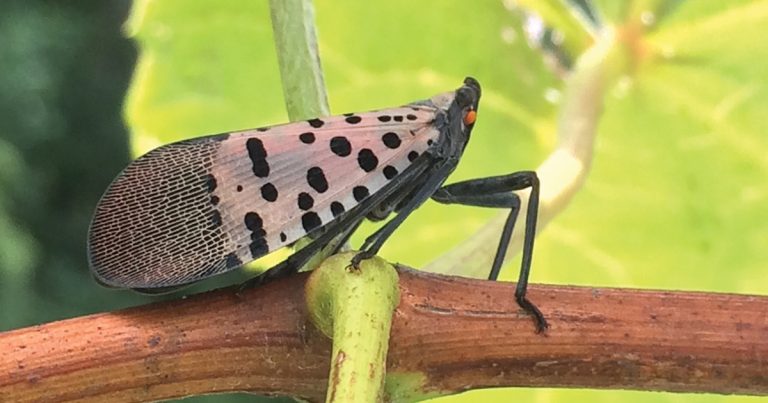
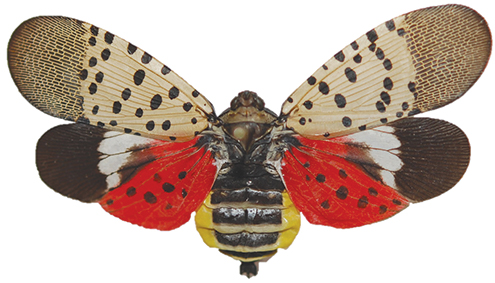
Adult SLF are approximately one inch long and 1/2 inch wide with wings folded. The forewing is gray with black spots near the base, and the tips are black with a dense series of lighter gray crossveins. The hindwings are bright red at the base and have an adjacent region that is black with a white band. The abdomen has black bands and appears black in early adults. As adults become more reproductively mature, yellow regions between the bands become more prominent, such that in September or October, the abdomen is large and mostly yellow in appearance.

Newly laid egg masses have a gray, mud-like covering, which can become dry and cracked over time. Old egg masses appear as four to seven columns of seed-like eggs, 30–50 eggs in total, and are approximately one inch long.

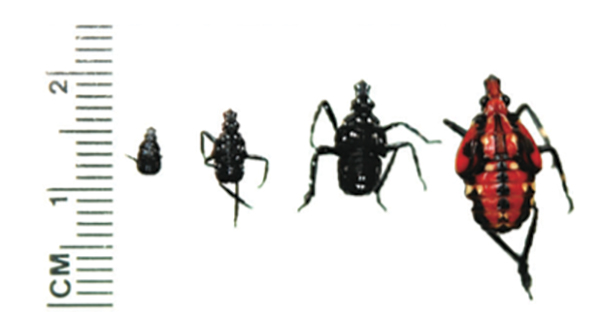
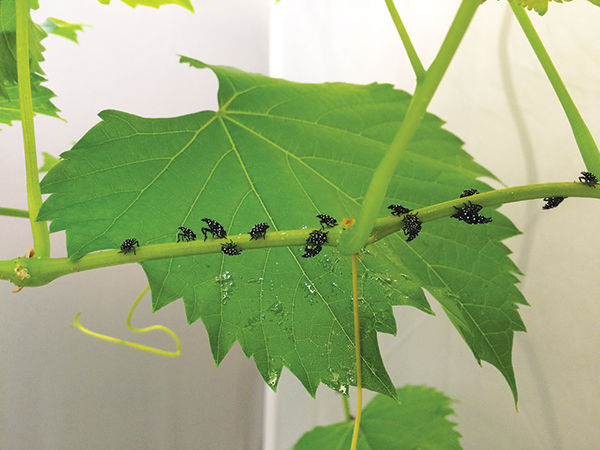
Hatched SLF nymphs are less than 1/4 inch long. The first three nymphal stages (which are also called instars) are black with white spots and appear “tick-like.” Fourth instars develop red patches on the body and are over 1/2 inch long. All SLF nymphs are wingless and incapable of flight.

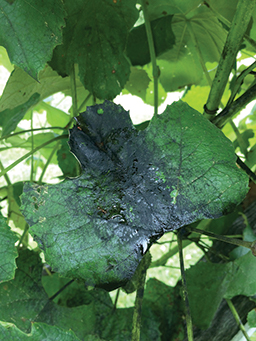
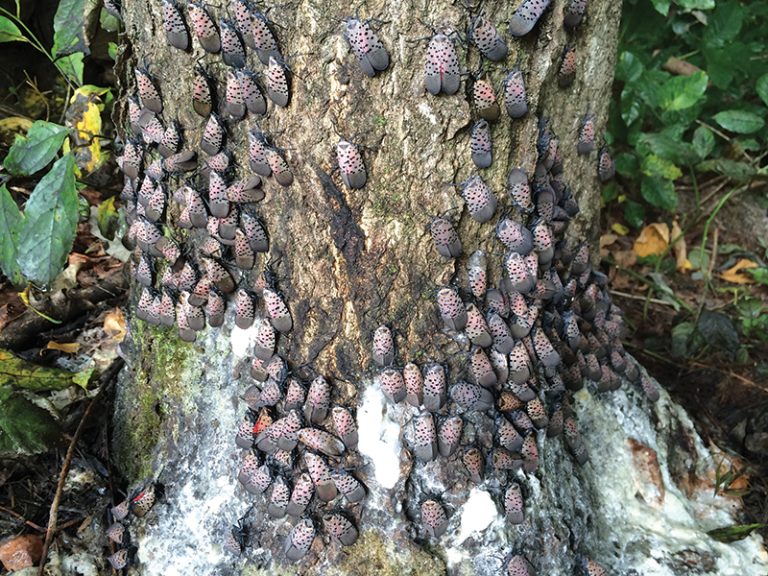
Trees of heaven, and some other host species, fed upon by aggregations of adults may exhibit weeping of sap along the trunk as well as build ups of honeydew excrement. Black sooty mold fungus grows on the honeydew on the tree as well as on surrounding soil and understory plants. Weeping sap and/or honeydew build ups attract ants, bees, wasps, hornets, and flies.
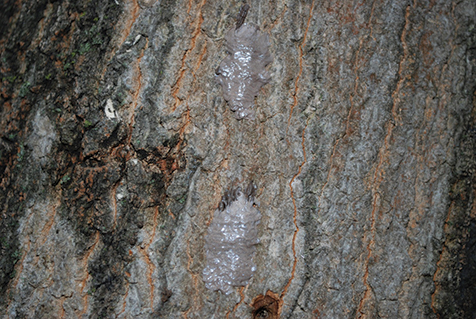
Egg masses of spotted lanternfly covered by waxy deposits on the side of a tree.
Egg masses of spotted lanternfly covered by waxy deposits. Photo by Pennsylvania Department of Agriculture.
Several black spotted lanternfly nymphs on leaf.
Early instar nymphs (1st through 3rd) feeding on grape vine. Photo by Erica Smyers, Pennsylvania State University.
Adult spotted lanternfly on grape vine.
Side view of adult spotted lanternfly on grape vine. Photo by Erica Smyers, Pennsylvania State University.
Four nymphal sizes of spotted lanternfly with ruler for size.
Four nymphal instars of spotted lanternfly. Photo by Pennsylvania Department of Agriculture.

Life Cycle

The SLF population overwinters as egg masses and has a one-year life cycle. In Pennsylvania, the first nymphs hatch in late April to early May. Nymphs develop through four stages before adults begin to appear in mid-July. Third and fourth instars and adults migrate to preferred host plants. In late summer and early fall, SLF move (via flying and walking) in high numbers into new habitats or onto previously non-infested or less infested hosts. This is likely due to the need to feed heavily to become reproductively mature, as adults mate at this time.

Spotted lanternflies can be seen feeding in high numbers on host plants at this time of year. Females lay eggs from late September through October, and dozens of egg masses can be found near adult aggregations. Eggs are deposited on tree trunks, limbs, and loose bark as well as any smooth surface, including stone, vehicles, trash barrels, outdoor furniture, and other man-made structures.

Sooty mold growing on the surface of a grape leaf.
Sooty mold growing on the surface of a grape leaf. Photo by Erica Smyers, Pennsylvania State University.
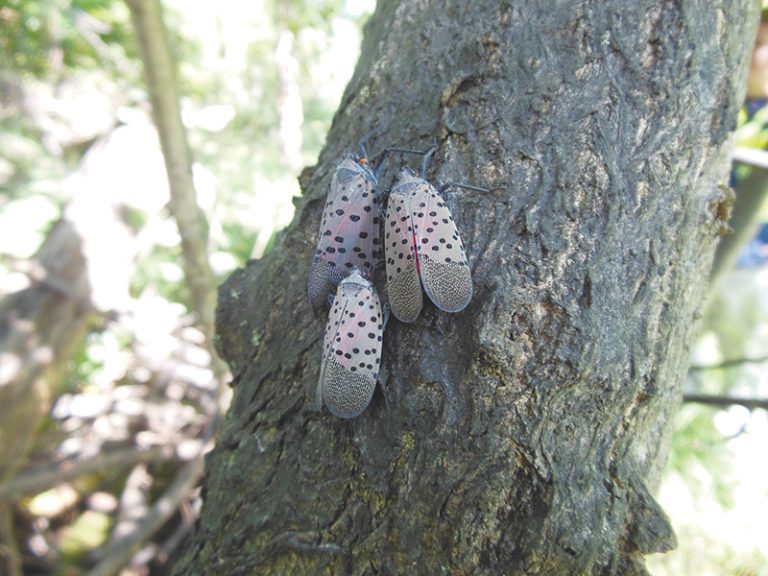
Three adult spotted lanternflies on a tree.
Three adult spotted lanternflies on tree trunk. Photo by Erica Smyers, Pennsylvania State University.
Adult spotted lanternflies aggregating and feeding near the bottom of a tree of heaven.
Adult spotted lanternflies aggregating and feeding on a tree of heaven. Photo by Erica Smyers, Pennsylvania State University.

Preventing Spread

Given that egg masses are laid on a wide variety of surfaces, this life stage may have the greatest potential for accidental spread. As of June of 2024, 17 states have established SLF populations and active quarantines; six other states have had detections without confirmed populations. The New York State Integrated Pest Management program maintains an interactive map to track SLF populations. Everyone within quarantine areas must avoid spreading SLF on vehicles and on cargo.

Nymphs are flightless and may pose less of a threat for spread. However, they have been observed feeding upon over 30 species of host plants in Pennsylvania, demonstrating the nymphs are mobile and capable of dispersing to some degree. The tree of heaven is considered an edge species and grows quickly in disturbed sites, including along roadways and powerline corridors. Corridors of tree of heaven may provide opportunities for SLF to spread.

Although SLF adults are capable of flight, they are relatively weak flyers, relying instead on strong jumping to evade danger. Mated females pose a high risk for establishing new populations by accidental transportation on vehicles, such as open bed trucks.

Management

There is no “one size fits all” approach to managing SLF. The best solution depends upon multiple factors, including the number and life stage of the SLF that are present, the host plant species being fed upon and its vulnerability to damage from the insect, the presence of other preferred host plants in the landscape. Management guides are available to aid in deciding whether and how to treat for SLF. Anyone in the known range of SLF must prevent moving them to new areas.

Report Sightings

Early detection is vital to the control of SLF. If you find an insect or egg case that you suspect is a SLF, you should collect it and immediately report it to authorities. Place the insect or egg case into a container of alcohol to kill and preserve it. Egg cases can also be collected into a ziplock bag and killed with hand sanitizer. It is important to record where you found the insect and include the
following information for each sample collected: date; substrate found on (e.g., species of tree, or for egg mass, structure it was found on); collector’s name; phone number; collection location including state, county, and address or nearest intersection; GPS coordinates, if available. To report the finding in Pennsylvania, report it to the Pennsylvania Department of Agriculture by calling 1-888-4BAAD-FLY (1-888-422-3359) or contact your local extension office. In Pennsylvania, use Penn State Extension.

Adult spotted lanternfly with wings spread, dorsal view.
Adult spotted lanternfly with wings spread, dorsal view. Photo by Pennsylvania Department of Agriculture.

Resource for more information:

Pennsylvania Department of Agriculture’s SLF page

Acknowledgements

Authors: Julie M. Urban, Department of Entomology, Pennsylvania State University; Erica Smyers, Department of Entomology, Pennsylvania State University; Lawrence Barringer, Pennsylvania Department of Agriculture; Sven-Erik Spichiger, Pennsylvania Department of Agriculture

For information about the Pest Alert program, please contact the North Central IPM Center at northcentral@ncipmc.org.

This work is supported by the Crop Protection and Pest Management Program (2022-70006-38001) from the USDA National Institute of Food and Agriculture.

July 2024