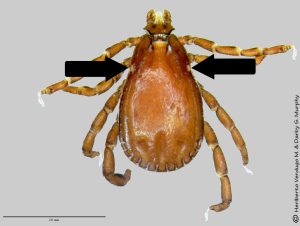
Asian Longhorned Tick
Free printed copies of pest alerts are available.
The Asian longhorned tick (ALT) (Haemaphysalis longicornis) is primarily a pest of concern in livestock (cattle, goats, sheep) and studies suggest there is a potential for the ALT to vector pathogens that cause Rocky Mountain spotted fever and other tick-borne illnesses. In its native range, the ALT can transmit Rickettsia japonica, which causes Japanese spotted fever, and the potentially fatal, severe fever with thrombocytopenia syndrome (SFTS) virus, among others.
Asian Longhorned Tick Facts
- Females can reproduce without mating with a male, which makes male ticks quite rare.
- Ticks have one blood meal during each life cycle stage.
- Females can lay up to 2,000 eggs.
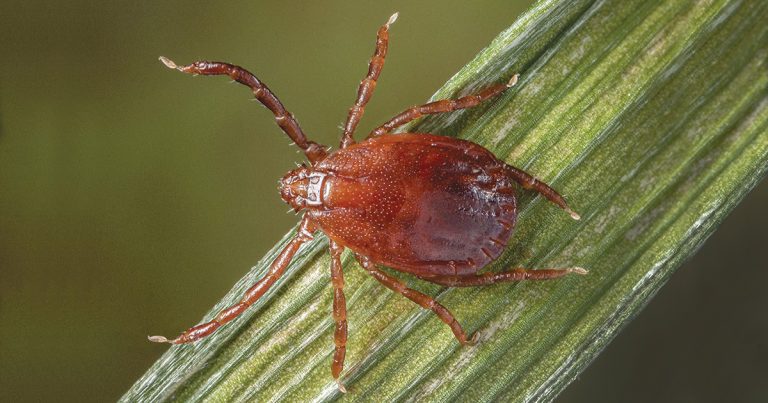
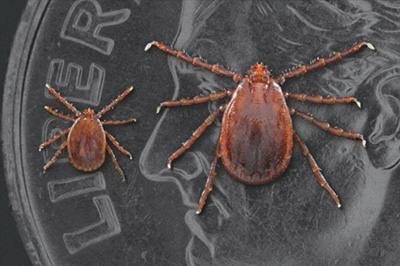
Origin and Distribution
The ALT is native to East Asia, with established populations in China, Japan and South Korea, and is considered invasive in Australia, New Zealand and the United States. The ALT was first believed to be discovered in the United States in August of 2017 on a tick-infested female Icelandic sheep in New Jersey. An unidentified tick specimen archived in Union County, New Jersey, now identified as an ALT, has moved the assumed introduction date to 2013. As of 2021, the ALT has been detected in primarily mid-Atlantic and southern states. For the current distribution, visit the USDA-APHIS website.
Life Cycle
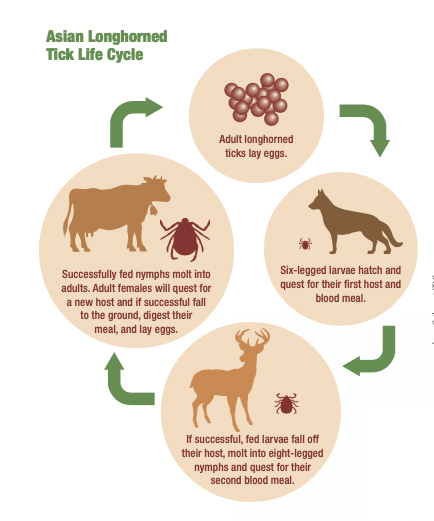
There are four life stages of the ALT. The ALT begins its life as an egg. The second life stage is the larval stage. At this point, the ALT is six-legged. The next life stage is an eight-legged nymph. The next and last life stage is the adult. Ticks take one blood meal as they transition to the next life stage. After each successful blood meal, the tick releases from its host, molts and then begins to quest for a new host. An interesting aspect of the ALT is that females can reproduce without mating with a male. This process is called parthenogenesis and as a result, male Asian longhorned ticks are rare.
Identification
The adult ALT resembles the adult brown dog tick shown below (Rhipicephalus sanguineus). To differentiate the two species, look for the presence of “eyes” on the sides of its body near the second row of legs, which is present on the brown dog tick.