
Pink Hibiscus Mealybug
Free printed copies of pest alerts are available.
The pink hibiscus mealybug (PHM), Maconellicoccus hirsutus (Green), thought to be native to southern Asia, is a serious pest of numerous host plants in many tropical and subtropical areas. In the United States, PHM was first detected in Hawaii in 1984, California in 1999, and since 2000 there have been detections in Florida, Texas, Louisiana, and Georgia.
Biological control efforts have been successfully implemented for all of these populations, which have shown significant impact on reducing this mealybug’s population density. However populations have persisted, and PHM continues to be found in new areas. The PHM infests a wide range of plants, including ornamentals, specialty crops and row crops.
Identification
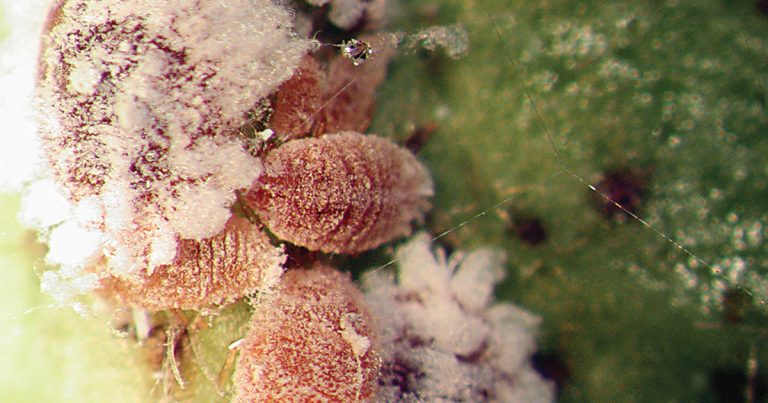
Female adult PHM are approximately 3 mm in length (1/10 inches), wingless, and have piercing–sucking mouthparts. A white cotton-like wax covers the female’s reddish body.
When punctured, the female’s body fluids are also reddish, but it is important to note that some other mealybug species may have a similar coloration. PHM egg masses are pinkish in color.
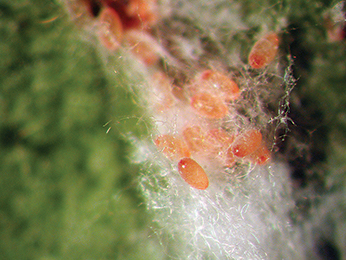
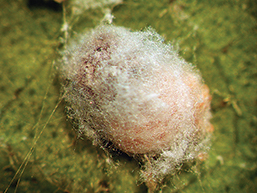
Newly emerged first instars, also called crawlers, are pink. Nymphs of both sexes resemble smaller versions of mature adult females. The male pupal stage is a sessile cocoon made of mealy wax.
The reddish-brown adult male PHMs are slightly smaller than the females, have one pair of wings and two long, waxy tails (caudal filaments). Because the adult males have nonfunctioning mouthparts and only live for a couple of days, adult males are not often observed in the field around plant material.
Life Cycle
Adult female PHMs have five life stages: egg, first instar (crawler), second instar (nymph), third instar (nymph), and adult. Adult male PHMs have six life stages: egg, first instar (crawler), second instar (nymph), third instar (prepupal), fourth instar (pupal), and adult.
Dispersal primarily occurs in the crawler and nymphal stages through walking, wind, or by hitchhiking on animal or plant material.
Unmated females produce a sex pheromone to attract males. After mating, females secrete an irregular-shaped white cotton-like egg mass that contains 300 to 600 eggs that turn pink as they mature.
First instars (crawlers) are pink and emerge from the eggs. In tropical areas, PHM remains active year-round and may produce up to 15 generations per year. In cooler areas, PHM overwinters in the egg or adult female stage in bark crevices, soil, tree holes, fruit, and crumpled leaf clusters.
Damage
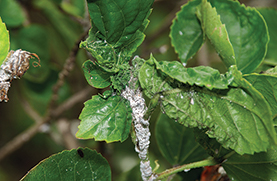
Heavy white, cotton-like, waxy buildup on branches and stems of host plants may indicate PHM infestations. Female PHM injects toxic saliva while feeding on fluids from many plant species, resulting in leaf curling similar to damage caused by viruses.
Heavily infested plants are stunted, fruits may be deformed, and shoot tips may develop a bushy appearance commonly referred to as “bunchy top.” Black sooty mold may develop on infested plant leaves as a result of PMH honeydew excretions.
Extremely high populations of PMH can kill plants. PHM is not known to vector any plant diseases.
Preventing Spread
If you suspect trees or plants are infested with PHM, contact your state’s university diagnostic laboratory for help. Field identification is not definitive.
Several other mealybugs may resemble PHM in the field. PHM samples for all new state or county records should be submitted for species-level confirmation. Because PHM is a regulated organism, management, destruction, and disposal protocols are coordinated by state regulatory officials.
If diagnosticians confirm PHM infestation of plants at nurseries or other commercial landscape facilities, quarantine measures will be implemented per state protocols. Due to a zero tolerance standard for PHM in nursery stock, the destruction of infested plant material and the application of prescribed chemicals may be recommended.
Each state’s local cooperative extension service, state department of agriculture, and USDA Animal and Plant Health Inspection Service personnel will determine if a biological control release is appropriate.
Management
The use of natural enemies has been shown to reduce PHM populations. In California, Florida, and Hawaii, the release of two parasitic wasps, Anagyrus kamali Moursi and Gyranusoidea indica Shafee, Alam & Agarwal (Hymenoptera: Entricidae) reduced and maintained PHM populations below economically damaging levels.
The predaceous lady beetle Cryptolaemus montrouzieri Mulsant, known as the mealybug destroyer, already occurs in the United States and has been effectively used to control limited PHM infestations. Adults are known to disperse when PHM populations drop to low levels.
This behavior allows PHM to increase its population densities above levels that are normally self-sustained by parasites alone. The larval stage of the beetle may be mistaken for large mealybugs due to their heavy wax coating, similar to PHM.
If you suspect you have a PMB issue, please contact your state’s diagnostic laboratory. The National Plant Diagnostic Network will help you find a local lab.
Acknowledgments
Revised by Laura Iles, Director of the North Central IPM Center.
Originally prepared by
• Editor: Julie Todd, Technically Correct Scientific Communications, State College, PA.
• Graphic designer: Gretchen Wieshuber, Studio 2D
• Reviewers: Amanda Hodges, University of Florida; Karolynne Griffiths, USDA–APHIS–PPQ; Dale Meyerdirk, USDA–APHIS–PPQ; and Lance Osborne, University of Florida
For information about the Pest Alert program, please contact the North Central IPM Center at northcentral@ncipmc.org.
This work is supported by the Crop Protection and Pest Management Program, project award no. 2022-70006-38001, from the U.S. Department of Agriculture’s National Institute of Food and Agriculture.
Any opinions, findings, conclusions, or recommendations expressed in this publication are those of the speakers and should not be construed to represent any official USDA or U.S. government determination or policy.
July 2024