
Lobate Lac Scale
Free printed copies of pest alerts are available.
The lobate lac scale, Paratachardina pseudolobata (Kondo and Gullan) (Coccoidea: Kerriidae), native to India and Sri Lanka, was first reported on hibiscus in Broward County, Florida, in 1999. It was found on several other hosts in Broward and Miami-Dade counties in 2000. It also has been subsequently identified in Hawaii.
Lobate lac scale has the potential to spread in warmer parts of the United States, and with a host range of over 300 woody plant species, it poses a threat to the landscaping and nursery industries by damaging or even killing plants.
This scale was previously identified as P. lobata, but a revision of the genus resulted in its description as a new species (Kondo and Gullan 2007).
Identification
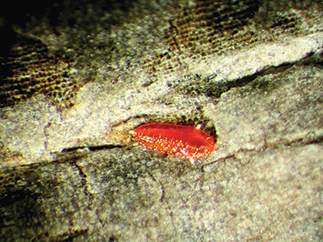
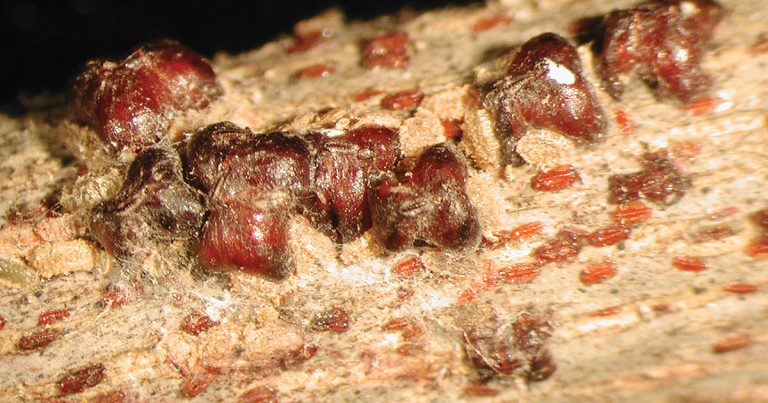
Mature scale females are about 1.5–2.0 mm (approximately 1⁄16-inch) long and wide and have two pairs of prominent lobes, resulting in the females having a unique X or bow-shape. The hard scale covering is generally a dark reddish brown, but it often appears dull and black due to a coating of sooty mold that forms on the scale.
Sooty mold is a type of mold that grows on honeydew, the excrement of plant-feeding insects like lobate lac scale. The first instars are elongate-oval, deep red, and very small (0.4 mm). The second instar begins to look similar to adults with four prominent lobes although it is smaller. Male lobate lac scales have not been observed in Florida or Hawaii.
Life Cycle
Lobate lac scale has four life stages: egg, first instar, second instar and adult. Females reproduce via parthenogenesis so the presence of males and mating are not necessary. A lac scale female produces eggs that are held beneath her outer shell until they hatch and the first instars emerge.
The first and second instars are immature stages and are called crawlers. Crawlers are the only mobile stage of scale insects. Newly emerged crawlers typically disperse by crawling to the nearest available food source; however, they also may be dispersed by air currents, wind, animals or movement of infested plants.
Once crawlers have settled on a new host, they remain immobile, maintaining the same feeding site for the remainder of their lives.
Host Plants
More than 300 species of woody plants have been determined to be hosts of lobate lac scale. Scale insects are often found on ficus, hibiscus, and wax-myrtle. Plants in the families Fabaceae, Myrtacea, Moraceae, and Malvaceae are frequently attacked.
Lobate lac scale also feeds on woody dicotyledonous plants, but it also has been found on one conifer (southern red cedar, Juniperus silicicola), on a palm, and occasionally on a few herbaceous species. Lobate lac scale is not likely to be a problem in greenhouses or houseplants, but it can be a severe pest in the landscape and in plant nurseries.
Damage
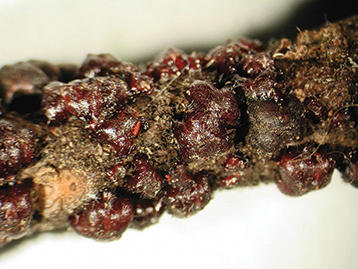
Lobate lac scale generally infests the woody portion of twigs and small branches. Less frequently, main stems of less than 2 cm in diameter are infested. On very susceptible hosts, high populations of the scale form a mass that looks like a dark, lumpy crust.
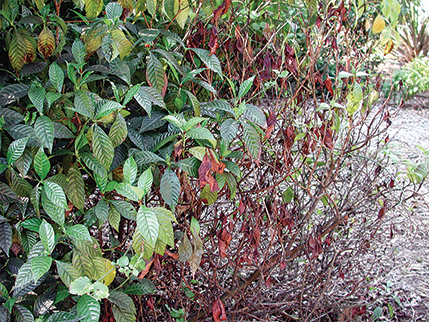
Sooty mold growing on the honeydew secreted by the scale covers the scales and branches and occurs in patches on the foliage. Branch dieback occurs in some plant species due to dense scale infestations, and in severe infestations shrubs and small trees have died.
Management
Quickly identifying a scale infestation and preventing spread to new areas is key in managing lobate lac scale. Once an infestation is established, treatment options become limited to branch or plant removal and destruction or treatment with insecticides.
Injections of systemic insecticides has been shown to cure and prevent infestation. Injections are usually only feasibly done on higher value landscape plants. Natural parasitism of lobate lac scale has not been observed in Florida or Hawaii, but research into and introduction of biological control agents may help manage populations in the future.
References
Cheng, Z.,& Bhandari, B. P. (2015). Biology, management, and updated host range of the lobate lac scale in Hawaii’s urban landscapes. College of Tropical Agriculture and Human Resources. University of Hawaii at Manoa. https://www.ctahr.hawaii.edu/oc/freepubs/pdf/IP-34.pdf
Howard, F. W., Pemberton, R., Hamon, A., Hodges, G. S., Steinberg, B., Mannion, C. M., McLean, D., & Wofford, J. (Reviewed 2017). Featured creatures: Lobate lac scale. University of Florida Institute of Food and Agricultural Sciences. https://entnemdept.ufl.edu/creatures/orn/scales/lobate_lac.htm
Bhandari, B. P. & Cheng, Z. Q. (2018). Lobate lac scale, Paratachardina pseudolobata (Hemiptera: Keriidae), in Hawaii’s urban landscape: Hosts and management. International Journal of Tropical Insect Science, 38(1), 71-76. https://doi.org/10.1017/S174275841700025X
Pemberton, R. W. (2003). Potential for biological control of the lobate lac scale, Paratachardina lobata lobata (Hemiptera: Kerriidae). Florida Entomologist. 86(3), 353-360. https://doi.org/10.1653/0015-4040(2003)086[0353:PFBCOT]2.0.CO;2
Acknowledgments
Revised by Laura Iles, Director of the North Central IPM Center.
Originally prepared by
- Catharine Mannion, Tropical Research and Education Center, University of Florida, IFAS;
- Forrest Howard, Fort Lauderdale Research and Education Center, University of Florida, IFAS;
- Greg Hodges, Florida Department of Agriculture and Consumer Services, Division of Plant Industry;
- Amanda Hodges, Southern Plant Diagnostic Network, University of Florida, IFAS.
Originally edited by Julie Todd, Technically Correct Scientific Communications, State College, PA.
Layout and design by Gretchen Wieshuber, Studio 2D
For information about the Pest Alert program, please contact the North Central IPM Center at northcentral@ncipmc.org.
This publication was produced and distributed by USDA–NIFA Integrated Pest Management Centers in cooperation with the National Plant Diagnostic Network, APHIS, and ARS.
This work is supported by the Crop Protection and Pest Management Program, project award no. 2022-70006-38001, from the U.S. Department of Agriculture’s National Institute of Food and Agriculture.
Any opinions, findings, conclusions, or recommendations expressed in this publication are those of the speakers and should not be construed to represent any official USDA or U.S. government determination or policy.
July 2024