
May 2025 Central Issue
News stories shared in the May 2025 Central Issue appear below. Subscribe to receive the Central Issue newsletter monthly via email.
North Central IPM Center Updates
Stay informed with the latest news from the Center with the stories below. Be sure to share your favorites!
Webinar Recording: Development of Laser Weed Control Robot for Sustainable Farming
Tired of weeds in your field? Watch them burn! Dr. Hongbo Zhang, assistant professor at Middle Tennessee State University shared his progress combining robotics with agriculture to improve weed management options. Dr. Zhang’s team has been working to develop an affordable and easy-to-operate robot to help farmers combat weeds.
Watch the full webinar to see the robot, both inside and out. And best of all, see the laser in action! How long do you think it takes to turn a weed into ash? This is your chance to find out.
June Webinar: Integrating Long-Lasting Insecticide Netting into IPM Programs after Harvest
Learn how to protect your harvest. Dr. Rob Morrison, research entomologist with the USDA Agricultural Research Service’s Center for Grain and Animal Health Research, and his team have been working on assessing the compatibility of long-lasting insecticide netting (LLIN) after harvest with a range of other integrated pest management tactics.
The team has found that LLIN is an extremely useful tool that can be combined with other strategies to increase their effectiveness as well. This presentation will demonstrate highlights of the project, which has resulted in >50 peer-reviewed publications; 137 invited and contributed talks at regional, national, and international meetings in 19 U.S. states and 11 countries; and 21 first or second place finishes in student competitions by mentored graduate and undergraduate students.
Register now and join the next Pests and Progress webinar on Wednesday, June 18, 2025, at 1:30 pm ET (12:30 pm CT) to learn more.
Certified Crop Advisers may receive 0.5 continuing education units (CEUs) related to integrated pest management (IPM) for attending.
Pests and Progress webinars are free, and you must register to attend. More details are on the North Central IPM Center website.

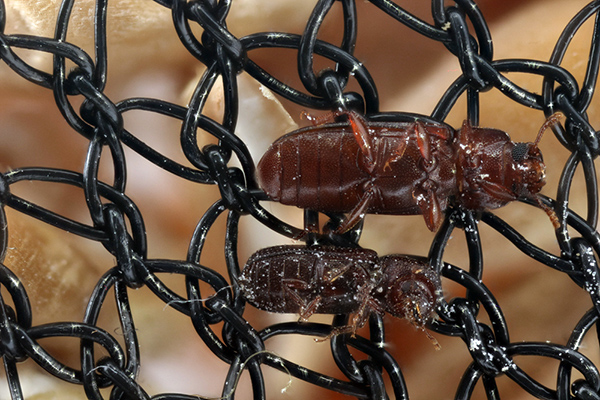
Insect pests trapped in insecticide netting. Photo provided by Dr. Morrison.
Reducing Pests in Schools Through Integrated Pest Management Webinar
Managing pests in schools can be challenging, but this free webinar provides an opportunity for you to learn from strategies that have succeeded. This webinar called, “Reducing Pests in Schools Through Integrated Pest Management” features three webinar speakers: Dr. Dawn Gouge, medical entomology professor and public health IPM specialist at the University of Arizona; and Dr. Marcia Anderson and Shanda Bennet from the EPA Center for Integrated Pest Management.
These three speakers share their experiences using integrated pest management (IPM) as a sustainable, proactive, and cost-effective solution for managing pests in schools. This webinar was recorded and is available for free once you register.
War Against Weeds Podcasts
- (Noxious) Weed Sniffing Dogs
Interviewees: Ngaio Richards from Working Dogs for Conservation, Amber Burch from Beaverhead County, and Josh Wagoner from the Montana Department of Agriculture.
New Episodes—I See Dead Plants Podcasts
- Tubers of Terror: Unearthing the Potato Cyst Nematode Part 1
Interviewees: Dr. Matt Back and Dr. Kasia Dybal from Harper Adams University. - Tubers of Terror: Unearthing the Potato Cyst Nematode Part 2
Interviewees: Dr. Matt Back and Dr. Kasia Dybal from Harper Adams University. - Tubers of Terror: Unearthing the Potato Cyst Nematode Part 3
Interviewees: Dr. Matt Back and Dr. Kasia Dybal from Harper Adams University.
Tick and Lyme Disease Awareness Special Section
May is Lyme Disease Awareness month. Catch up on the latest tick news.
Johns Hopkins Medicine Lyme Disease Research Center: Lyme Disease Awareness
In addition to regular research related to Lyme disease, the Johns Hopkins Medicine Lyme Disease Research Center provides a number of helpful resources. Learn to recognize Lyme disease rashes and view a map showing where Lyme disease has been found in the United States.
Buckeye Tick Test (OH)
It’s an important time to monitor tick populations, species and disease instances in Ohio. The Ohio State University is now offering “Buckeye Tick Tests” to identify the tick species and screen for disease-causing pathogens. Results are available within 72 hours. The test costs $49.99 per tick and is available to the public. After receiving the test results, individuals are encouraged to share the information with their medical providers and/or veterinarians.
Learn more about the tick species in Ohio and the screening panels that are performed with a Buckeye Tick Test.

TickReport Testing and Mapping
Tick identification and testing is available from TickReport. Mail your tick sample to have the tick identified and tested for up to 20 pathogens. The cost is $60 and is available throughout the United States. Data from previous testing has been mapped so you can also view how common tick species and diseases are in your area.
Engaging High School Students in Science Using Ticks
Students learn best when they have an opportunity to actively engage with their lessons. Ted Snyder, a high school teacher and officer in the US Army Reserve, combined his teaching and training for a high school science lesson. After learning about tick species and identification, the students also built tick sweeps to collect samples and visited a local park to monitor for tick activity.
Which Tick Species Bite People?
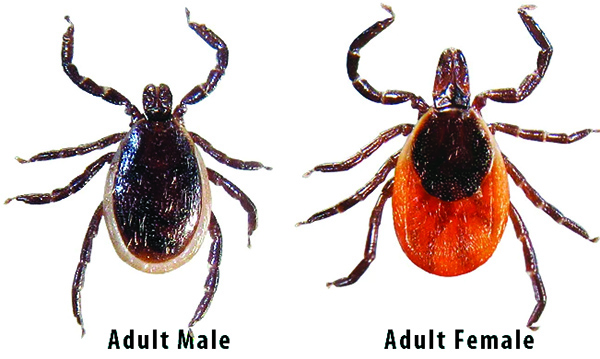
How many tick species actually bite people, and which species bite most often? Results from over 100,000 tick samples reveal the four species most likely to enjoy a human meal, along with other region-specific tick species that also attach to people.
Tick and Lyme Disease Research
May is Lyme Disease Awareness month. Catch up on the latest tick and Lyme Disease research.
Taking the Bite out of Lyme Disease
An antibiotic called piperacillin shows promise for treating Lyme disease. Even better, the dosage necessary for curing Lyme disease is much smaller than similar antibiotics and also has fewer effects on the gut biome.
Researchers from Northwestern found that piperacillin disrupts the cell wall production that is unique to Lyme bacteria (Borrelia burgdorferi), which stops both growth and division of the bacteria.
Piperacillin is already approved as a treatment for pneumonia in people.
A second study out of Northwestern may explain why Lyme disease symptoms persist after treatment. The body may have an immune response to cell wall pieces that remain after treatment and linger in the liver. Researchers found that these cell wall pieces can remain for weeks or even months.
Tick Feeding or Vaccination with Tick Antigens Elicits Immunity to the Ixodes Scapularis Exoproteome in Guinea Pigs and Humans
Armor against tick bites? Yes please! Rare antibodies in the immune system of some individuals can force ticks to detach prematurely. Researchers are learning from these antibodies and are experimenting on guinea pigs to learn what it takes to share this tick resistance between individuals. The hope is that it may be possible to create an anti-tick vaccine.
Special Journal of Maine Education Center
Check out this special issue of the Journal of Maine Education Center, which is focused on tick-borne diseases. While many of the articles are focused on Maine, several articles focus on pediatric cases of tick diseases and co-infections. The article called, “Lyme Disease: A Call for A One Health Approach,” is especially relevant as it calls for a collaborative, consistent approach to diagnosis and treatment.
Permethrin-Treated Uniforms Show Protection Against Tick-Borne Disease in Service Members
The Defense Centers for Public Health-Aberdeen (DCPH-A) has operated the Military Tick Identification/Infection Confirmation Kit program since 1989. Data from 2013 to 2021 was used to compare the effects of adding a permethrin treatment to military uniforms. Significantly fewer engorged ticks came from individuals who wore clothes treated with permethrin.
The effectiveness of permethrin-treatment does decline over time. Washing gradually removes the permethrin.
Resources
Read, use or share the latest IPM resources.
Identification Technology Program
Be sure to bookmark this resource! The Identification Technology Program includes a collection of over 48 identification aids on its website that focus on identifying species that pose a risk to U.S. agriculture, natural resources, and our trading partners.
Check out the identification tool to find help identifying diseases, pests, and hive issues in honey bees or to distinguish between invasive hornets and look-a-like species. There are resources focused on grape pests ants, aphids and many more.
This resource is part of the U.S. Department of Agriculture’s Animal and Plant Health Inspection Service’s Plant Protection and Quarantine division, and each resource has been carefully prepared and reviewed for accuracy.
GROW: Bringing Research and Tools for Integrated Weed Management to Farmers
A recent webinar featuring speakers from Getting Rid of Weeds (GROW) describes the latest details on integrated weed management topics such as cover crops, harvest weed seed control, and precision weed management.
This webinar is part of The IPM Toolbox” webinar series from the Northeastern IPM Center.
2024 Regional Corn Rootworm Monitoring Network Summary
Review the results from corn rootworm monitoring efforts in the Midwest in 2024. Data, including dominant beetle species, are organized by location and by crop sequence.
Events
Learn and network at these upcoming in-person events.
Plant Health 2025
Registration is now open for “Plant Health 2025,” the annual meeting of the American Phytopathological Society. The 2025 event will be held on August 2-5, in Honolulu, Hawaii, and the theme is “Global Communities Collaborating to Address Global Risk.”
Job Board
Consider applying for these job opportunities.
Director of Center for Sustainable Small Farms and Urban Agriculture, Prairie View A&M University
Endowed Chair in Raspberry Breeding