Gulf Coast Tick

Free printed copies of pest alerts are available. 

The Gulf Coast Tick (GCT, Amblyomma maculatum) is a medium-sized, hard tick found primarily in the southeastern and Gulf Coast regions of the United States with a range that continues to expand. Recognizable by the silvery-white markings on its back, this hard tick is a vector for a number of diseases of human and veterinary importance.

The GCT is native to the United States, specifically from the east coast of Texas to North Carolina. GCT are found in grassland areas or shrubby areas with minimal tree cover.

GCT used to be confined primarily to coastal regions, but more recently have spread much more widely and can be spread by migratory grassland birds. Habitat restoration to native grasslands combined with warmer winters could be two factors in the spread of GCT.

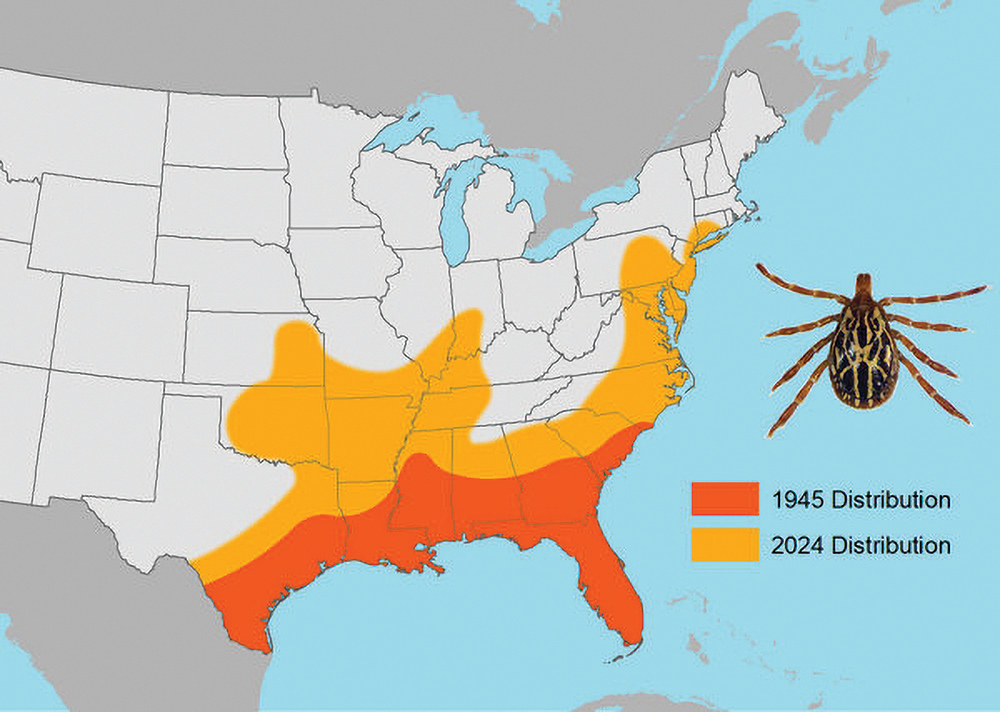
Map of the continental United States showing the range of the Gulf Coast tick and how its population expanded from the South between 1945 and 2024. The population is now present in parts of Oklahoma, Kansas, Missouri, Arkansas, Illinois, Indiana, Kentucky, Tennessee, North Carolina, Virginia, Maryland, Pennsylvania, Delaware, New Jersey and Massachusetts.
Generalized distributions of the Gulf Coast tick (pictured), a human-biting tick species newly established in the northeastern United States, in 1945 compared with 2024. Figure by Jay Kiser from Goudarz Molaei et al. Reproduced with permission.

Identification

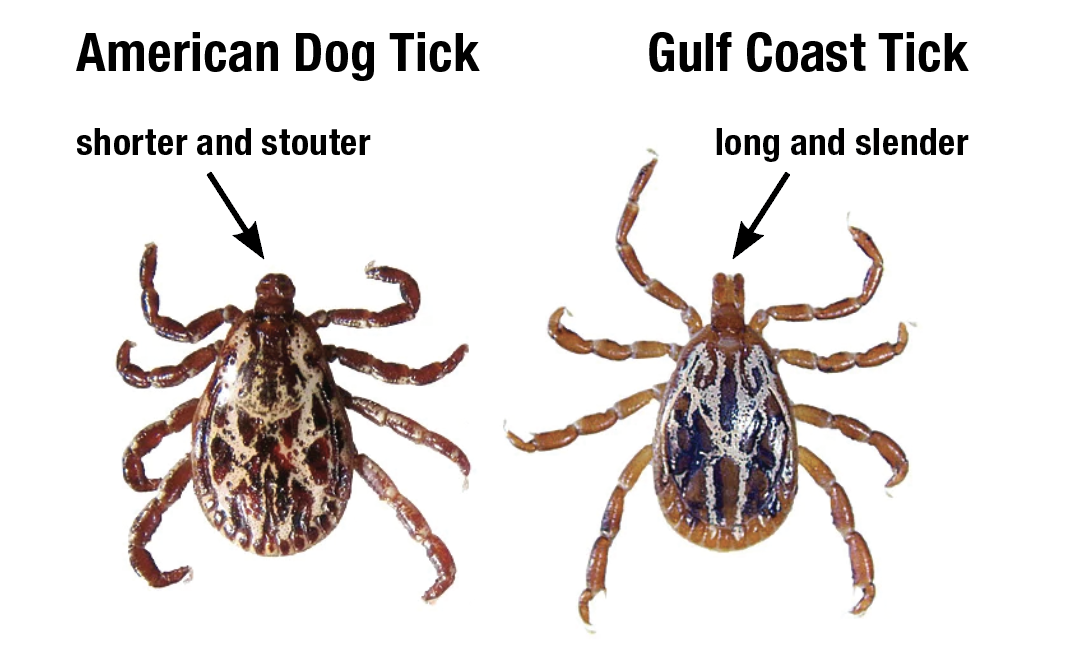
The GCT is commonly mistaken for the American dog tick (Amblyomma maculatum) due to similar appearance. One key method of distinguishing the two species is the shape of the mouthparts: the American dog tick has short, stout, trapezoidal mouthparts while the GCT has long, narrow, rectangular mouthparts.
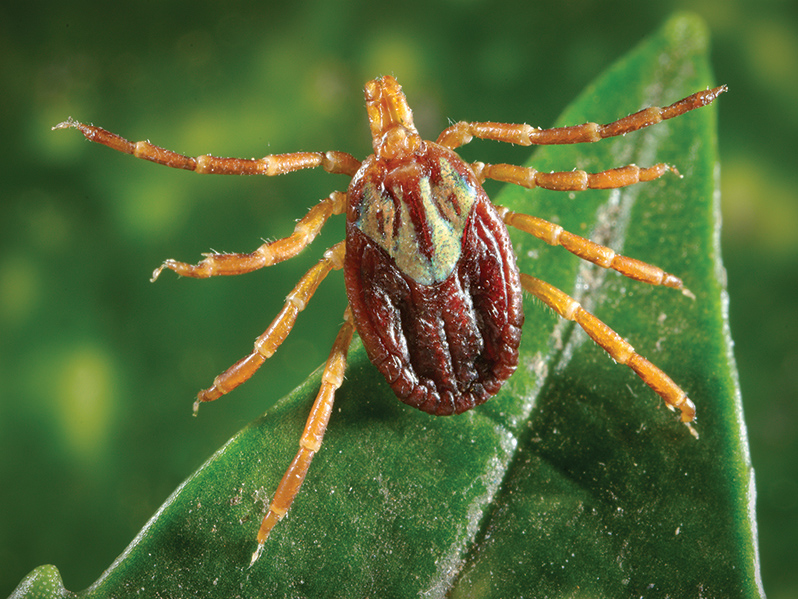
Adult female Gulf Coast tick
Adult female Gulf Coast tick. Photo by Dr. Christopher Paddock, Centers of Disease Control Public Health Image Library.
Adult American dog tick showing short mouthparts. Adult Gulf Coast male tick showing long mouthparts.
Differentiating American dog tick and Gulf Coast tick by their mouthparts. Photos by University of Rhode Island TickEncounter.

Life Cycle

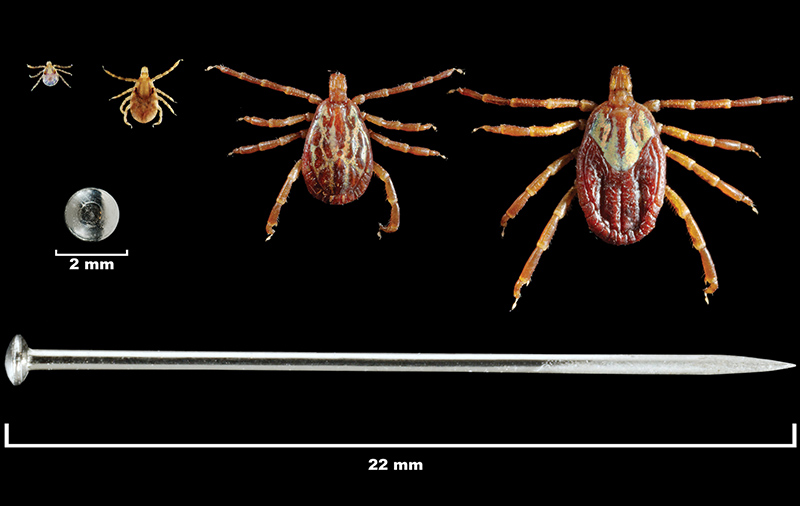
The GCT has four life stages: egg, larva, nymph and adult. After hatching, the larval ticks are about the size of a pinhead and have only three pairs of legs.

The nymphal stage is larger, around the size of a poppy seed, and has the typical four pairs of legs. Adults are the width of a pencil, have four pairs of legs and are sexually dimorphic.

At each active stage, the tick must successfully attach to a host and obtain a blood meal before molting and progressing to the next life stage. The immature tick life stages favor smaller animal hosts, like rodents and raccoons, but they regularly use birds as well.

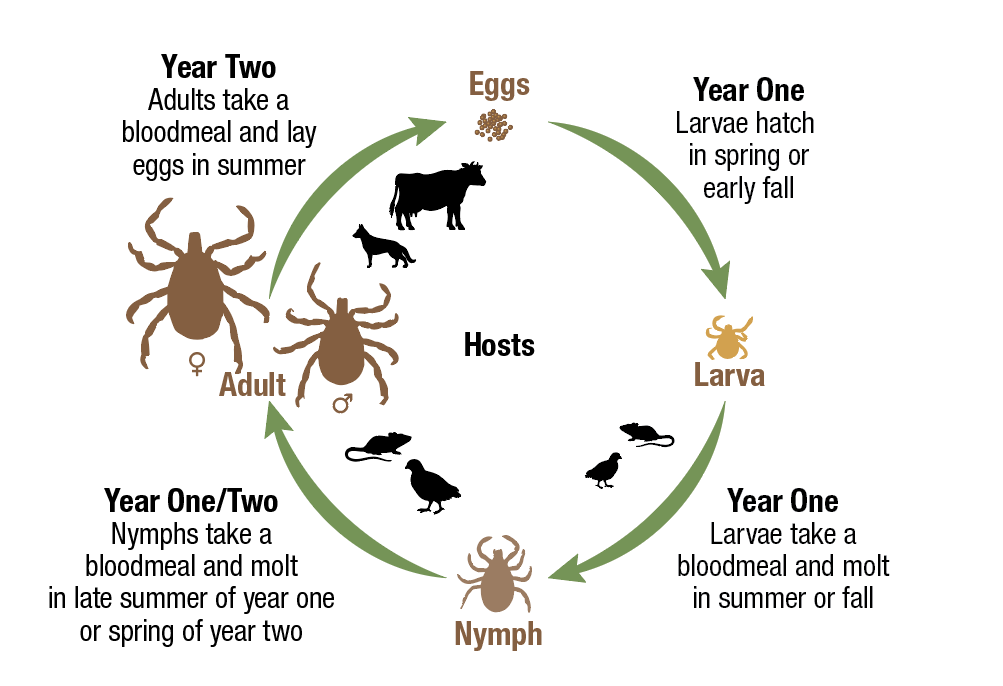
Gulf Coast tick life cycle. Year 1: eggs hatch into larvae in spring or early fall. Larvae take a blood meal and molt into a nymph in summer or fall. Nymphs take a blood meal and molt in late summer (year 1) or in spring (year 2). Year 2: Adults take a blood meal and lay eggs in summer.
Life cycle of the Gulf Coast tick.

After a successful blood meal, GCT will typically drop off the host to molt and seek out a new host, requiring a total of three hosts to progress through the lifecycle. Adults tend to favor larger mammals, such as deer, cattle, horses, companion animals and humans.

Both adult males and females require a blood meal before mating; then the female can produce eggs.

Health Concerns

In humans, the GCT is known for being the primary vector for Rickettsia parkeri rickettsiosis, a bacterium in the spotted fever group Rickettsia. Compared to the Rocky Mountain spotted fever, Rickettsia parkeri rickettsiosis tends to be a milder infection.
These GCTs can cause tick paralysis in both humans and other mammals, although this is uncommon. The attached ticks release toxins that affect motor neurons, leading to paralysis and respiratory failure. Once the tick is detached, full recovery is typically observed within 24 hours.

In animals, GCT is the principal vector of Hepatozoon americanum, the causative agent of American canine hepatozoonosis in the Southeastern region of the United States. This is not spread by the tick infecting the host via bite, but by the host consuming an infected tick during grooming.

In the lab, GCT has also been shown to be a competent vector of Ehrlichia ruminantium, the heartwater pathogen, a fatal disease that affects both wild and domestic ruminants.

Approximate size of the Gulf Coast tick. Photo by Dr. Christopher Paddock, Centers of Disease Control Public Health Image Library.

Management and Prevention

In outdoor spaces, landscape management strategies are important. Maintain a short lawn length (less than 3”); have a maintained gravel or woodchip barrier between the lawn and natural spaces; and trim back overhanging shrubs and foliage.

Using an EPA-registered repellent and wearing long-sleeved shirts and pants are important when outdoors, especially in ideal tick habitats. After spending time in tick environments, be sure to perform tick checks on pets and people.

Ticks often hide in hair, ears, armpits, near the groin and behind the knees. Washing and drying clothes on high heat after returning from tick environments will kill any ticks still attached to the clothing.

If a tick is found attached, grab onto the tick as close as possible to the skin using fine-tipped tweezers and pull directly upwards. Make sure the mouthparts are removed with the tick.

Resources

For more information on the Gulf Coast Tick, view this fact sheet from Ohio State University Extension.

Acknowledgments

Authored by the Public Tick IPM Working Group. For more information visit the Public Tick IPM Working Group website.

Thank you to Jay Kiser for assistance in creating the distribution map originally published in Emerg Infect Dis. 2024 Oct;30(10):2208-2211. doi: 10.3201/eid3010.240821.

This work is supported by the Crop Protection and Pest Management Program, project award no. 2022-70006-38001, from the U.S. Department of Agriculture’s National Institute of Food and Agriculture.

Any opinions, findings, conclusions, or recommendations expressed in this publication are those of the authors and should not be construed to represent any official USDA or U.S. government determination or policy.

For information about the Pest Alert program, please contact the North Central IPM Center.

July 2026