North Central IPM Center Updates
Webinar Recording: Crop Advisors’ Perspectives on Pesticide Resistance Management
Be sure to check out the latest Pests and Progress webinar featuring Dr. Katherine Dentzman, a rural sociologist with Iowa State University. Dentzman has created a survey and analyzed responses to understand what influences growers to adopt new practices, such as integrated pest management (IPM) practices, and what prevents them from making changes.
The first barrier to adoption of IPM practices is individualism. Growers prefer to be in charge of the management decisions for their own land, and they don’t want to tell neighbors how to farm, either.
Another barrier is techno-optimism. Growers tend to be very optimistic that a new management strategy, particularly a pesticide tool, will be created to adequately manage any weeds, insects or diseases that threaten profits.
Of course, a third barrier to IPM adoption is cost. New practices must work, but they also must be affordable.
Dentzman shares additional survey results, including where growers get advice, and whether crop advisors are concerned about herbicide resistance, insecticide resistance or fungicide resistance. Dentzman also gives specific advice for encouraging adoption of IPM practices:
- Build relationships and trust before suggesting any changes
- Extension professionals show up on the list of who growers and crop advisors both work with. This shows the importance of Extension agronomists, Extension programs and financial support for them
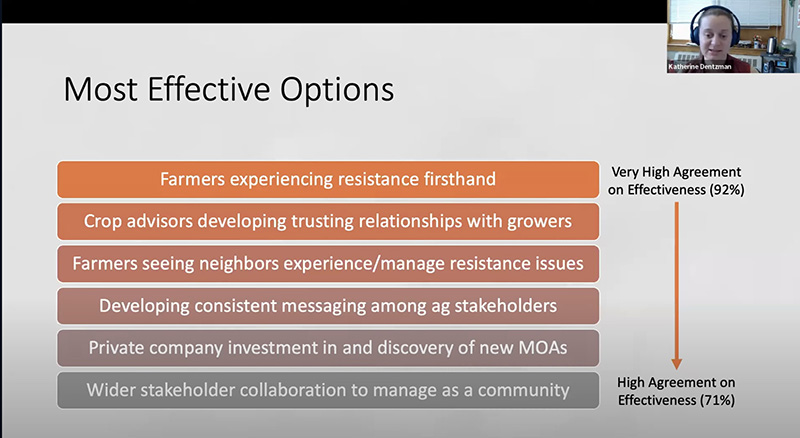
Finally, growers who experience resistance firsthand understand the importance of avoiding additional resistance problems. It’s important to have management strategies ready and available for when growers become interested.
Learn more by watching the full recording on the NCIPMC YouTube channel. The next Pests and Progress webinar will be in mid-March.
Two related papers have also been published using the certified crop advisor survey data and results.
“Perspectives of Certified Crop Advisers on Pesticide Resistance Management” was published in Crops & Soils, and “Barriers to the Effective Management of Herbicide-Resistant Weeds: Perspectives from Crop Advisors” was published in Outlooks on Pest Management.
New Amur Corktree Plant Alert Available
The Public Gardens as Sentinels Against Invasive Plants (PGSIP) Working Group has created a new plant alert for the Amur Corktree.
Check out the alert to learn how to identify this tree. Details about where it grows, how it affects native tree species, and how it spreads are also included.
The Public Gardens as Sentinels Against Invasive Plants Working Group currently includes participants from 38 public gardens across the United States, and 11 ranked the Amur corktree according to PGSIP standards.
The team is working to identify other plant species that are being reported to escape from cultivation within botanic gardens and arboreta before they become part of the horticultural market. Other public garden collaborators are welcome to join. Email PGSIPadmin@mortonarb.org to get involved.

Registration is Available for Sustainable Landscaping Workshops
The Midwest Grows Green Lawn & Land Forum invites you to its upcoming Sustainable Landscaping Workshops across Greater Chicago on March 19-20, 2024.
On Tuesday, March 19, the event will begin with the “Natural Lawn Care Workshop” at the Experimental Station in Chicago’s Hyde Park neighborhood. Join in to learn about natural lawn care practices, policies and strategies from North Shore Country Club golf course superintendent Dan Dinelli and Iowa City Community School District grounds manager Ben Grimm.
You will also have a chance to observe a turfgrass installation at the Ray Elementary schoolyard, which was done using compost topdressing instead of synthetic chemicals.
Register here for $35.
Wednesday’s workshop will focus on sustainable landscaping practices for invasive weed management. Join in the “Viable and Safe Alternatives to Glyphosate Workshop” at the Lakeview Center at Gillson Park in Wilmette, Illinois.
The session’s keynote speaker, Dr. Mark Renz from the University of Wisconsin-Madison will share strategies to manage invasive weeds with limited chemicals, along with how to establish native plants to replace weeds.
This workshop includes a walk through Gillson Park grounds where the Midwest Grows Green team will describe the strategies the Technical Assistance Program recommended to the Wilmette Park District to control the invasive weed lesser celandine. Register here for $35.
New Episodes—I See Dead Plants Podcast
- Wheat and Barley Scab? – USWBSI to the Rescue
Interviewee: Dr. Darcy Telenko from Purdue University - I’m Dreaming of a Green Christmas and Maybe a Few Bugs Part 1
Interviewee: Dr. Deb McCullough from Michigan State University - I’m Dreaming of a Green Christmas and Maybe a Few Bugs Part 2
Interviewee: Dr. Deb McCullough from Michigan State University - Bird Poop Helps to Understand Bird-Crop Relationships
Interviewee: Dr. Daniel Karp of U.C. Davis
IPM Highlights
Insect Eavesdropper: Digital Monitoring of Crop Pests Via Vibrational Signals
The “Insect Eavesdropper” uses a contact microphone and a minicomputer to identify the vibrational signals of insects feeding on plants. The Insect Eavesdropper is able to detect, classify the insect to species, and count the number of insects that are directly feeding on a plant.
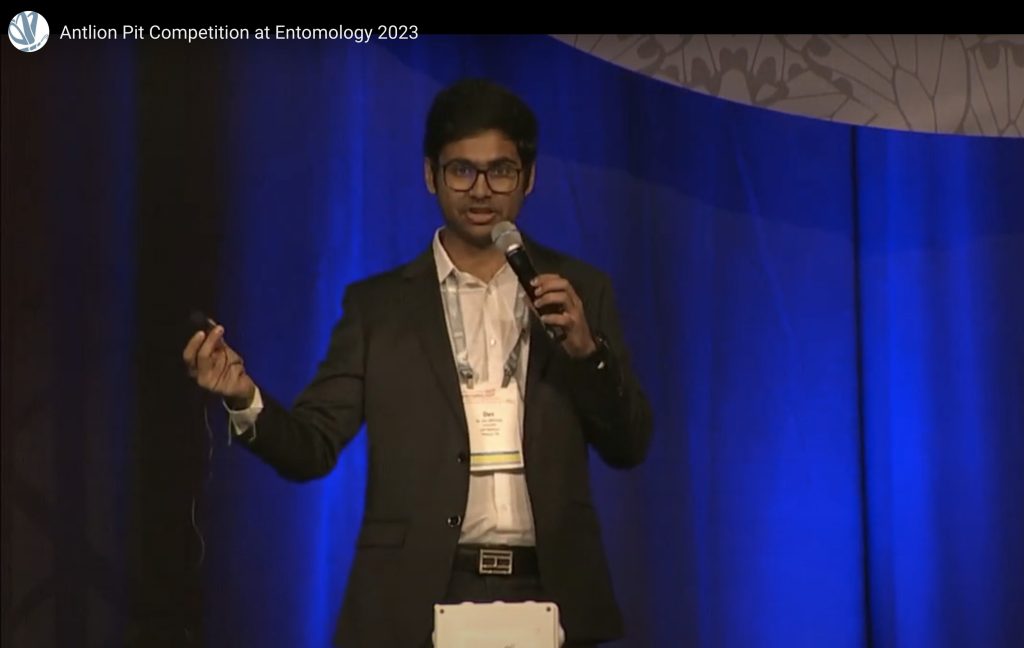
Dr. Emily Bick, BCE-Intern, assistant professor in the Department of Entomology at the University of Wisconsin-Madison (UW), and UW Master’s Student Dev Mehrotra developed the Insect Eavesdropper for the Antlion Pit innovation competition, winning first place in 2023.
Call for Papers for Frontiers Special Issue: Pest-Smart Strategies For Improved Eco-Efficiency In Agriculture, Forestry And Communities
Frontiers is seeking research paper submissions related to eco-efficiency and IPM. Eco-efficiency is the ratio comparing costs to benefits of pest management that is used in agricultural settings.
Impacts both within and outside of agricultural production are relevant. The manuscript summary submission deadline is February 29, 2024. The deadline for completed manuscript submissions is September 30, 2024.
Preparing for Next Season
Beginning Farmer Virtual Program
This 8-week virtual training will teach participants how to set goals, identify assets and challenges, and become aware of outside assistance and resources that can lead to a successful farming operation. Sessions will be held using Zoom on Monday evenings from 7:00 PM to 8:30 PM ET (6:00 to 7:30 PM CT) from February 5 to March 25, 2024.
The registration deadline is January 31. The cost is $85 per person, and space is limited. This opportunity is offered by Purdue University so content may be most relevant in Indiana.
CPN TV Returns with New Topics and Experts for 2024
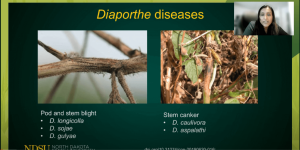
The Crop Protection Network (CPN) has produced a new series of CPN TV episodes featuring experts from around the United States and Canada with topics ranging from soybean Diaporthe to Italian ryegrass. CPN TV is available on the CPN website.
Increasing Lawn Durability in Urban Landscapes
While turfgrass landscapes are valued by many urban homeowners, a monoculture of turfgrass is vulnerable to insect pests. Control measures for these insects typically include insecticides since there are not many control options available. Recent trials suggest that planting other plant species is a way to reduce pests and improve plant quality.
Michigan Ag Ideas to Grow With
The 2024 MI Ag Ideas to Grow With conference will be held virtually from February 19 to March 1, 2024. Participants can choose which sessions to attend with topics ranging from fruit and vegetable production, to row crops, the environment, and community food systems. All sessions are free, but you must register to attend.
Genetic Sleuthing Reveals New Weakness in Corn’s Herbicide Armor
A genetic vulnerability has been found in 49 corn varieties that makes it susceptible to tolpyralate herbicide. To avoid crop losses, growers may want to choose a different herbicide or choose a tolpyralate-tolerant corn variety.